AI as operator, not widget
Chat is the interface for actions: documents, tasks, messages. The model must understand context and trigger flows - not only generate text.
Case study · Web + Mobile App
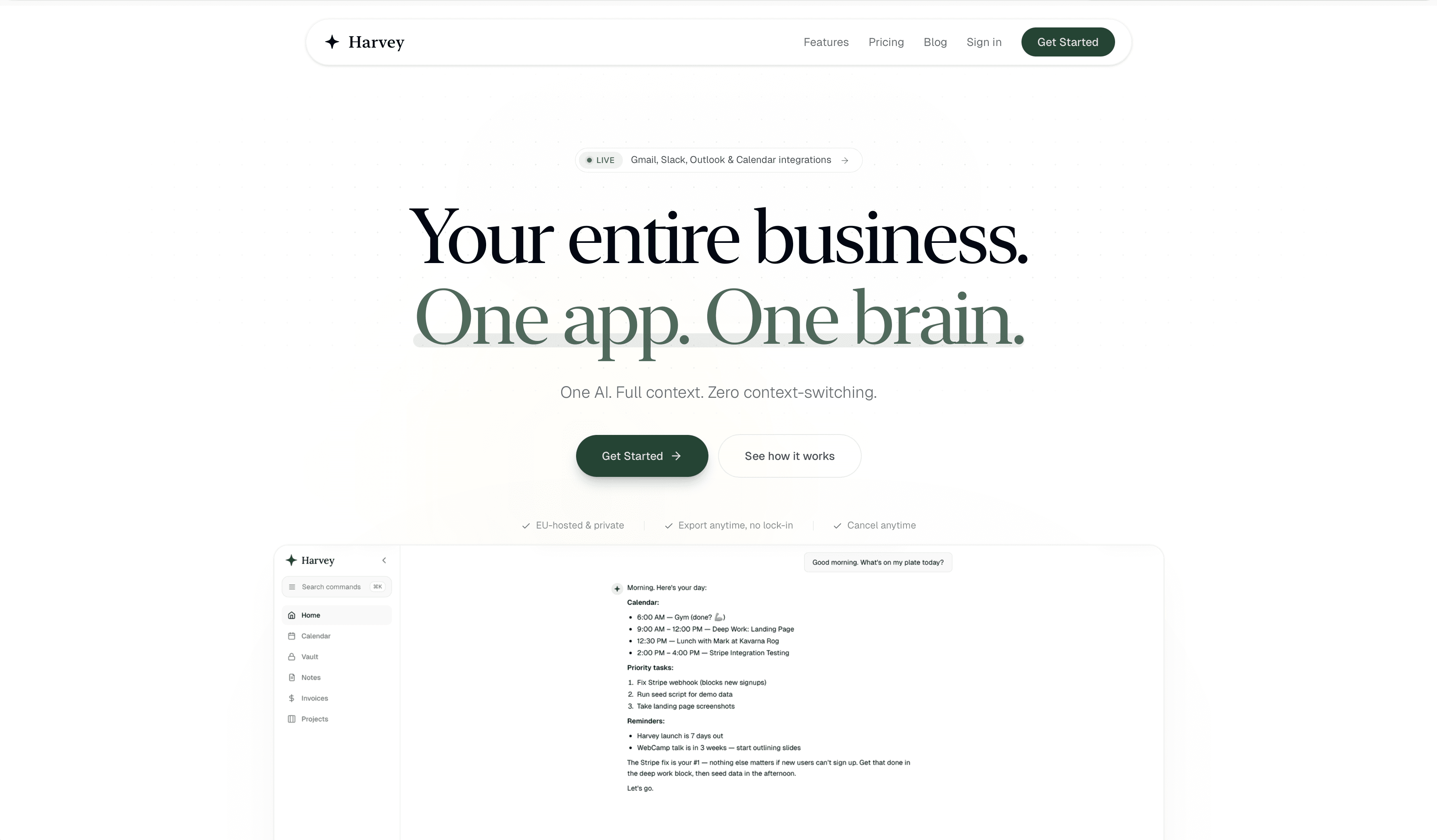
Harvey was a substantial product build: an AI core, subscriptions, role-based access and a full module system - from canvas and documents to invoices, tickets and chat.
AI
Claude + OpenAI
RBAC
Roles & permissions
Subs
Subscription model
7+
Core modules
Harvey was not “another AI chat”. The goal was a personal AI operator - an app that helps run your day on your behalf: messages, documents, tasks, invoices and support, with the feel of a product rather than a demo.
That kind of project grows complex fast: authentication, subscriptions, different roles, files, conversations, admin and reliable AI behaviour. Without clear architecture you end up with a pile of features that do not connect.
We needed a mobile-first experience with a strong AI core and a backend that can scale - plus modules that are useful alone and together form an operating system for the user.
We built in modules around one AI core. Claude and OpenAI cover conversation and actions; Supabase stores users, roles and data; Next.js APIs on Vercel orchestrate agents and integrations; React Native (Expo) carries the mobile experience.
Subscriptions and role-based access were part of the design early - not “we will add billing later”. Without them an AI product has no usage boundaries and teams cannot safely share access.
Chat is the interface for actions: documents, tasks, messages. The model must understand context and trigger flows - not only generate text.
A subscription model bounds and monetises usage; roles separate owner, members and admin. That is the foundation of a real product, not a toy.
Canvas, documents, invoices, tickets and chat are separate modules with a shared AI and data layer - easier to ship and clearer UX.
Product map
A conversational operator with Claude/OpenAI - context understanding, task execution and links into app modules.
A subscription flow for feature access and role-based permissions for safe sharing inside a team/account.
A workspace plus file/document management - where AI and user collaborate on real material.
Operational modules for invoices, support tickets and communication - so Harvey covers more than a single chat screen.
Harvey grew into a full AI application with real product depth: not just prompt demos, but a system with billing, files, roles and subscriptions.
For the client that means a foundation the product can grow on - with architecture that can take new modules, instead of starting over.
This case study shows that Tim Blažič can lead complex AI and product builds - not only marketing sites. If you need a web/mobile app with AI features, subscriptions, roles and multiple modules, this is relevant proof.
A good fit for startup teams and companies that want a solopreneur developer with end-to-end ownership: product decisions, UX, React Native/Next.js, Supabase and AI integrations - with direct communication and a clear scope.
Tell me what you need - a managed small-business website or a custom project. I’ll reply in under 24 hours.